Johannes Vermeer: Life, Art, and Masterpieces of the Delft Painter
Who says an artist can’t be both a master of light and a merchant trying to make rent? Right here in California, you see plenty of folks juggling their passion with a day job. It’s a whole vibe. But back in 17th-century Holland, one genius named Johannes Vermeer wrestled with those exact struggles, leaving behind some of the most captivating art ever known. This Delft Painter’s whole story is deep, kinda tragic, and hella influential.
A Life Began During Global Upheaval: The World of 1632
Imagine this: The world in 1632 was a hot mess. Over in India, construction on the iconic Taj Mahal had just kicked off, a colossal monument that would take two decades to complete. Europe, brutal war. Meanwhile, Europe was deep in the Thirty Years’ War, a nasty conflict that would claim an estimated eight million lives. Heavy.
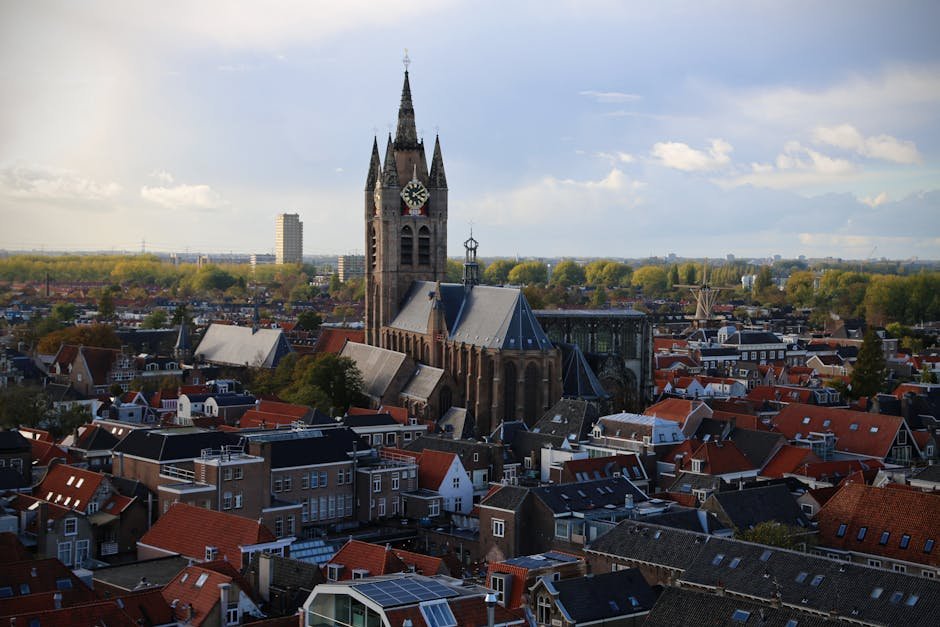
Across the Atlantic, the United States was barely a twinkle in a king’s eye, with new colonies like Maryland just starting to pop up. With all this global drama, a quiet little town in Holland, Delft, welcomed a baby boy. That boy? Johannes Vermeer.
From Innkeeper’s Son to Art Dealer: Vermeer’s Early Influences
Vermeer wasn’t born into fancy circles. Nope, just a regular middle-class guy. His dad, Reynier Janszoon, first worked in textiles before opening an inn and tavern. These spots were like the chill hangouts of their era. Busy places where travelers could eat, drink, sleep, and socialize.
Also, his dad was an art dealer. So young Johannes grew up surrounded by art and making a buck, an informal education that totally shaped his future. When his father passed in 1652, Vermeer, then just 20, stepped right up. He took over the family’s art dealing business and the inn. His mother, Digna Baltens, isn’t much written about, but history hangs onto the names of those who truly changed the game.
Love, Faith, and Social Challenges: Vermeer’s Conversion for Marriage
Love makes you do wild things. For Vermeer, it meant a huge life change. At 21, he married Catharina Bolnes. Her mom, Maria Thins, was a super devout Catholic. And she apparently had one deal-breaker condition for the marriage: the young Protestant-raised Vermeer had to convert.
He did. This wasn’t a small decision in mostly Protestant Holland; converting to Catholicism might’ve been tolerated, sure, but it definitely wasn’t celebrated. It was a risk for love. A commitment that moved him into Catharina’s mother’s big apartment, where they would eventually have 15 children. Sadly, four heartbreakingly passed away in childhood.
Guild Membership and the ‘Fijnschilders’ Movement
The same year he married and converted, Vermeer got into the prestigious Guild of Saint Luke in Delft. Big deal for any artist. A true mark of professional recognition. He was clearly influenced by the “Fijnschilders” movement, a hugely popular art style back then.
These painters were famous for their almost hyper-realistic, incredibly detailed, and naturalistic small-scale works. And you can absolutely see that precision in Vermeer’s later canvases.
Domestic Worlds and the Strength of Women in His Art
Vermeer’s early work leaned towards mythological and religious themes, like “Christ in the House of Martha and Mary.” But around 1656, something shifted. He started zooming in on everyday life. And who did he paint? Women.
Unlike many of his peers, who were busy with portraits of wealthy families or elites, Vermeer often focused on ordinary women in home settings. He painted women 40 times, compared to just 14 male figures. These weren’t women just posing. No. They were often busy doing things: reading, writing, working. He celebrated the diligent, dedicated women who ran 17th-century households. Many art historians suggest the repeated items in his paintings—carpets, pitchers, maps—point to him painting from within his own home. Pretty cool.
The Master of Light and Hidden Details
Vermeer’s use of light is legendary. It’s almost always shown entering from the upper left, often through a window. This wasn’t just for looks. He expertly used this light to highlight specific elements and set up his scenes with incredible depth. He often had this subtle movement in his figures. A blur of motion in a brushstroke, catching them mid-action, even though the ‘Fijnschilders’ were known for static styles.
His “still life” elements? Straight-up remarkable too. Those maps, often seen hanging on walls, weren’t just background fluff. Holland was a map-making center in the 17th century, obsessed with exploration and trade. These maps totally showed what was happening in society. Some even suggest he used a camera obscura—a dark room projecting an image—to get his perfect perspectives without visible sketches. A proto-photographer, perhaps?
Vermeer’s color scheme was as rich as the era itself. While he used many colors, he had a notorious obsession with lapis lazuli, that stunning ultramarine blue. This pigment was incredibly expensive, straight from Afghanistan. And despite his money troubles, he splurged on it. You can see its vibrant depth in pieces like “Girl with a Pearl Earring,” where it’s said he used it as a base layer. “The Lacemaker,” a tiny masterpiece in the Louvre, even shows surprising, abstract blurred areas. A bold move for such a precise artist. And another thing: “Girl with a Pearl Earring” herself, a real icon. Her turban and pearls hint at Eastern trade and status.
Then there’s “The Art of Painting,” where he paints himself from behind, facing a muse. It’s a statement. Probably asking about an artist’s worth in a world that often looked right past them. Sometimes, art has a funny way of predicting a life.
Financial Hardship and Lasting Artistic Legacy
Vermeer’s financial struggles are a stark reminder of the hard truth for many artists. When the French invaded Holland in 1672, the economy tanked. No one was buying art, not Vermeer’s own paintings, nor the art he tried to sell as a dealer. Kids needed food. He was supporting 12 hungry children, and the pressure was immense.
According to his wife, he became depressed. Fell ill. And died shortly after, in poverty and under immense stress. He wasn’t cranking out work, producing only about three paintings a year. A tiny output compared to his peers. Many of his works ended up with a single patron, which, while offering some stability, also meant he couldn’t raise his prices to combat inflation.
Vermeer had no students to carry on his unique style, and his genius faded from public memory for nearly two centuries. It wasn’t until a journalist and art critic named Thoré-Bürger rediscovered and championed his work in 1866 that Vermeer finally got international fame. His paintings, now among the most celebrated in the world, are spread across seven different countries.
He died broke and burdened, much like Van Gogh. Never knowing the hella global acclaim his mastery of light, detail, and regular home stuff would achieve. Yet, his legacy of bold color, quiet dignity, and radical precision continues to inspire. A testament to art’s enduring power, even when the artist himself can barely pay the bills.
Frequently Asked Questions
Q: Where’d Johannes Vermeer pop up?
A: Delft, Netherlands, 1632.
Q: So, why the religious switch?
A: Had to. Maria Thins, his future mother-in-law, was super Catholic and demanded it for him to marry Catharina Bolnes.
Q: What made his stuff different?
A: Instead of rich folks or big historical moments, he painted normal women doing everyday things. Celebrating real life.