The Tiny Thing That Runs Everything: Your Brain on Transistors
What’s the single most important invention in human history? Fire? The wheel? Big deals, sure. But check this out: A tiny, nearly invisible gadget powers practically everything you touch daily—your phone, the internet, maybe even space travel. For real, every cool new bit of tech, from AI to electric vehicles, exists because of one basic piece of transistor technology. It’s the core of our whole digital vibe, a total game-changer that defines Silicon Valley. And here’s the kicker: this deep dive into the microscopic world? Totally rooted in quantum physics. Crazy, right?
Transistors: Switches for the World
Remember old computers? The kind that filled entire rooms, weighing tons. Now? You’re probably reading this on your phone. Little thing. That’s billions of times more processing power, all because of something called a transistor.
Transistor? Just a switch. It controls the flow of electricity, turning it on or off. This simple trick lets computers speak their language: binary code. Ones and zeros, on or off. Thanks to these silent, super-fast switches. They work with no moving parts. Millions of times quicker than any physical button ever could. And another thing: they can also boost signals. This dual superpower? Huge for computing.
Semiconductors and Silicon: The Guts
So, how do these tiny wonders tick? It’s all about materials called semiconductors. See, metals (conductors) always let power through. Glass (insulators) blocks it. But semiconductors? They’re in-between. They conduct electricity only when you tell ’em to. Under specific conditions.
Silicon’s the MVP here. On its own, an insulator. But heat it up. Or, more commonly, “dope” it. Doping means injecting other atoms, like phosphorus. Adds an extra electron. Makes an “n-type” semiconductor. Or, throw in boron atoms. Creates an electron “hole.” Poof. “p-type.” Simple.
Stick an n-type and p-type silicon together? Bam. Diode. Zaps flow one way. Stack a p-type between two n-types (or flip it)? You just made a transistor. It uses a small zap at its “base” terminal. This opens or closes the current flow between the “emitter” and “collector.” Like a tiny faucet valve.
Microchips: Shrinking It All Down
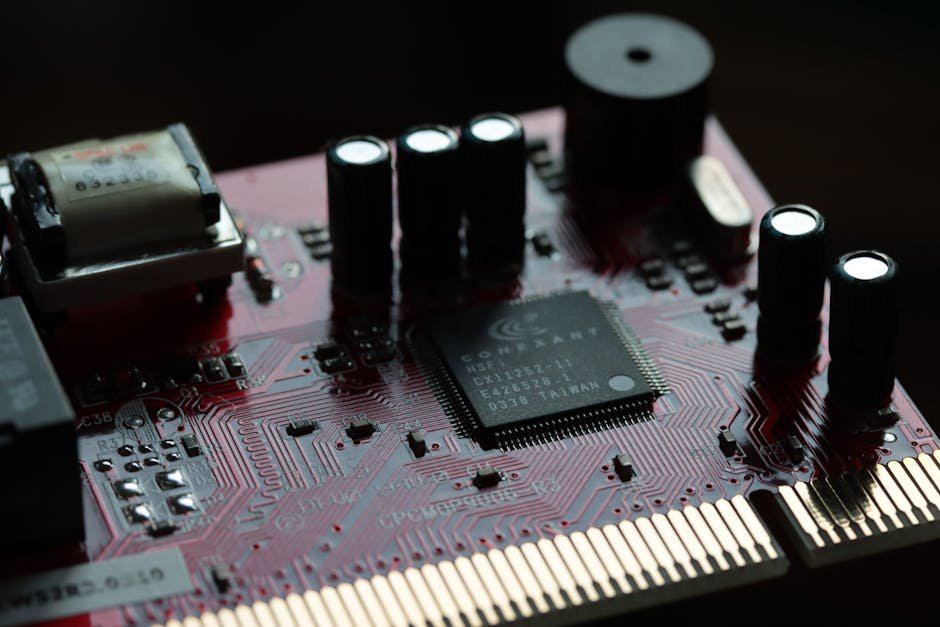
For transistor technology to truly blast off into the digital age, it needed to shrink. A lot. This led to a massive leap: integrated circuits. What we just call microchips. These tiny chips pack endless transistors, diodes, and resistors onto one small piece of silicon.
Guys like Robert Noyce drove this innovation. He invented the first integrated circuit using silicon. Later, he co-founded Intel Corporation with Gordon Moore. These two physicists? They started it all for the big tech companies now. And that’s why the region became Silicon Valley. Noyce literally named the place.
Moore’s Law: Making Things Smaller, Faster
Gordon Moore, that Intel co-founder? He made a famous prediction. Moore’s Law. Basically, the number of transistors on a chip would double roughly every year. This wasn’t just a wild guess. It became true. Pushed engineers to keep shrinking stuff. Year after year.
Check this out: ’70s, about 10,000 transistors on a 120mm chip. ’80s? A million. By the late ’90s, those familiar Pentium MMX chips packed 50 million transistors. Fast forward to the late 2000s, and we hit a billion. Today, even an iPhone 7 carries over two billion microscopic transistors. Seriously. This crazy shrinking act turned room-sized machines into powerful wristwatches. What a journey for transistor technology.
But hey, big problem. Moore’s Law is hitting a wall. A giant, physics wall. Get too tiny? Classical physics breaks. Hard to halt electrons. Switches flake out.
Quantum Physics & Transistors
So, this is where quantum physics steps in. The first transistor guys—William Bradford Shockley, John Bardeen, and Walter Houser Brattain, all physicists—won the Nobel Prize in 1956 for their game-changing device. Their early work on atomic and electronic connections in semiconductors? Pure physics, baby.
When we miniaturize more, we leave Newton’s world behind. Hello, weird world of Niels Bohr and Werner Heisenberg. To fix up transistor performance at the atomic scale? Gotta dive deep into quantum mechanics. And that helps us figure out particles so small, they just don’t make sense to our everyday brains.
Quantum Computing: The Next Big Thing
Old transistor technology is struggling. So, next up is quantum computing! Whole separate topic, for sure. But here’s the gist: use quantum weirdness to solve problems even today’s biggest supercomputers can’t touch.
Science is all connected. Seriously. Abstract quantum stuff and making tiny chips? All mashed up. Builds our future tech. Maxwell, Einstein, Planck. And loads more. Their ideas show: one small science step equals huge human leaps. The future of computing, it seems? Still super quantum. What a time to be a part of it!
FAQs
What’s a semiconductor?
It’s a material, like silicon. Can act like an electrical conductor, or an insulator. Depends on things like heat, or when you add impurities. Pretty key for all electronic gadgets.
Who invented the first integrated circuit?
Robert Noyce. He made the first microchip using silicon. Later, he also co-founded Intel Corporation. Big deal for modern personal computing.
What does Moore’s Law predict?
Moore’s Law says the number of transistors on a chip will roughly double every year. This means more computing power. Smaller devices. And cheaper, too, over time.